"Fire Humanities explores personal stories, public perceptions, and broader narratives around fire. By understanding humans’ varied cultural, emotional, and aesthetic relationships to fire, the project seeks to engage with it in healthier ways. "
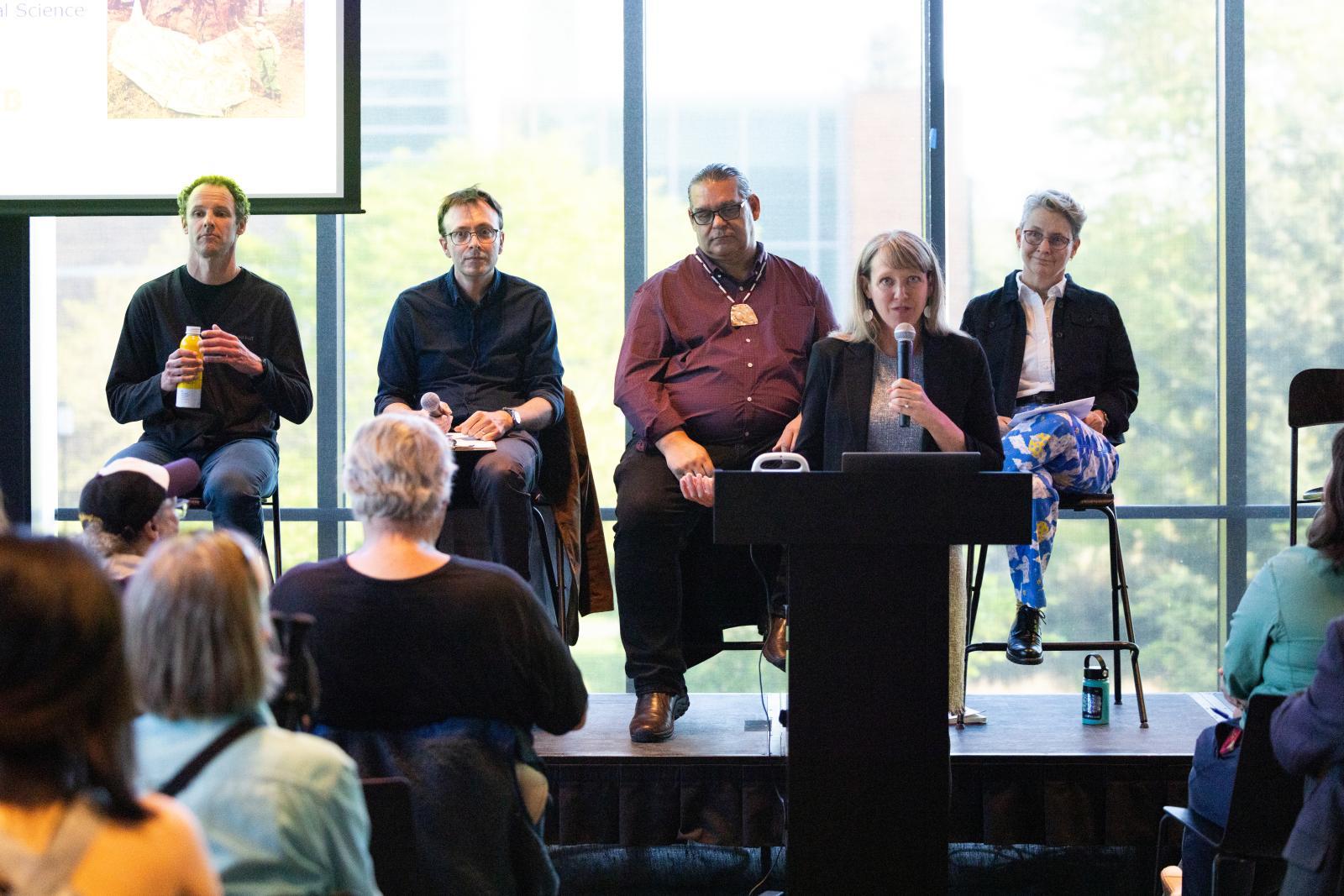
In late April, the Simpson Center sponsored a Fire Humanities panel at the University of Washington's Burke Museum of Natural History and Culture. The panel featured five scholars discussing their work researching fire and smoke, creating art, and engaging the public. All panelists are contributors to the Fire Humanities edited book project, born out of the University of Idaho’s Confluence Lab.
Confluence, perhaps, conjures an image of two rivers meeting at a single spot. The word also carries a more expansive meaning: “a situation in which two things join or come together.” Confluence is an apt name for the lab, based in Moscow, Idaho, which brings together scholars in the arts, humanities, and sciences, with community members, to engage in research projects on environmental issues impacting rural communities. The word is also an apt descriptor of what we do in the humanities, and what the Simpson Center and Confluence Lab are currently building together.
The Confluence Lab and the Fire Humanities book project are the brainchildren of Jennifer Ladino and Erin James, both English professors at the University of Idaho. James and Ladino, together with artist and fire practitioner Sasha Michelle White, dreamed up the Fire Humanities project to foster interdisciplinary inquiry into what it means to live well in a world with more fire and more smoke. As a complement to fire science, Fire Humanities explores personal stories, public perceptions, and broader narratives around fire. By understanding humans’ varied cultural, emotional, and aesthetic relationships to fire, the project seeks to engage with it in healthier ways.
Ladino, a UW alumna and Simpson Center Society of Scholars fellow in 2005-06, explains the Fire Humanities collaboration as “a community-building piece of work, not like most edited collections [with] people sitting alone and then sending the editors their drafts.” She believes that “humanities scholars are really good at doing that intellectual work, but also potentially creating new stories, new forms of art that are hopefully going to reshape conversations about fire and maybe even management of fire.” The project also seeks to engage wider—and hopefully, bipartisan—audiences in Idaho and elsewhere through community-based research and public-facing events.
To launch, project leaders secured funding from the National Endowment for the Humanities (NEH). Originally awarded in August 2024, that funding was revoked in April 2025 following major cuts to the NEH by the Department of Government Efficiency (DOGE). Those cuts devastated humanities projects and organizations across the country. For Ladino and James' Fire Humanities project, the cuts meant a reduction in funding for graduate students, the loss of a post-doctoral fellowship position, and the cancellation of workshops.
Jesse Oak Taylor, Professor of English here at UW and a contributor to the Fire Humanities book, came up with the idea of continuing the project's work by organizing a panel in Seattle. When Taylor and the Simpson Center learned of the NEH cuts, they were already planning to host Stephanie LeMenager, a professor of English at the University of Oregon and another contributor to the Fire Humanities volume, in Spring 2026. Taylor had nominated LeMenager, a prominent Environmental Humanities scholar, to be a Solomon Katz Distinguished Lecturer in the Humanities, which entails a week-long series of events that brings lecturers into intellectual conversation with faculty, graduate and undergraduate students, and community members.
The week started off with LeMenager's Katz lecture. She shared examples of art and poetry that grapple with how humans interpret, understand, and interact with fire; asserting that, in the midst of crisis, art, poetry, and literature offer profound ways of getting us to see one another and see other ways of life. While acknowledging that beauty may seem a strange value or quality to evoke in the context of megafire, she argued that “beauty can be a means of carrying both memory and community along” in the wake of trauma or upheaval. She spoke about the humanities’ role in helping us to understand climate change from cultural standpoints and advocated for cultivating time in the moment, being in community with others, and taking up work that resonates locally.
The bookend to this lecture, at the close of the week, was the Fire Humanities panel at the Burke Museum. It featured David G. Lewis and Andreas Rutkauskas, in addition to Ladino, LeMenager, and Taylor. Panelists considered dominant cultural narratives—propaganda even—around fire and the ways that extractive, colonial processes have worked against Indigenous practices that often have cultivated fire as part of stewarding homelands.
David G. Lewis, an Assistant Professor of Anthropology and Indigenous Studies at Oregon State University, a member of the Confederated Tribes of Grand Ronde, and self-described “archival sleuth,” shared a story about the Clatskanie tribe based on a note he found and deciphered in the John Peabody Harrington Collection. The story provided an example of Indigenous communities modifying their practices based on the effects of catastrophic fire. He suggested that major fire events may have encouraged tribes to establish prescribed burning practices, which involve intentionally setting contained fires to manage lands, restore ecosystems, and reduce the risk of larger wildfires. Also sometimes called "cultural burns," these are becoming more a part of mainstream fire science and fire management. The move toward accepting that there can be “good fire” and away from the idea that all fire must be suppressed, reaffirms what many people have known for millennia -- fire is a part of life.
During the panel, speakers also highlighted fire as a topic that can open dialogue across political divides. Andreas Rutkauskas, a landscape photographer and lecturer at the University of British Columbia, Okanagan campus, spoke about using photographs of less-commonly represented aspects of megafire to help people connect and to counter more sensationalist imagery that we often see in popular news media.
Ladino shared three things that she learned through Confluence Lab interviews with community members in the Pacific Northwest. First, everyone has a fire story. Second, these stories are inherently emotional. And third, fire brings an opportunity to discuss environmental issues without automatically alienating people skeptical of human-caused climate change. She dreams of a time when people who want to be good stewards – like tribal members and ranchers – will come together to promote “good fire” on the lands they love.
A multi-stage, weeklong conversation like this is the kind of thought-provoking exchange that we aim to generate through the Katz Lecturer visits. According to Taylor, “There’s a fullness to the way that these weeks go that I think is really beneficial. It’s great to have [an] illustrious speaker come give a great talk, you go home and say ‘wow that person’s smart’. But this does a lot more.” In addition to the lecture and the panel event, LeMenager's Katz week included a seminar with graduate students, a visit to Taylor’s mixed undergraduate and graduate class on "Whale-Worlds," and a colloquium for faculty and students about Energy Humanities.
While Katz lectures aim to share exciting and fresh humanities scholarship with broader audiences, they also bring faculty into deeper conversation with students and with one another, enabling them to reflect on and revalue classroom experiences. During the colloquium, LeMenager shared her belief that humanities methods should be opened up, with a shift toward more collaborative, project-based work. Taylor noted that teaching a class is like generating an artifact, building something with students that is a singular creation. And Ladino reflected on the value of humanities methods, particularly close reading. “To me, that means reading the text and hearing and seeing what's there but also being a good participatory listener. And that has traction way beyond writing or even art, but in face-to-face human interactions… which helps us be better at reaching [across] divides of all kinds.”
The week after LeMenager's Katz visit, a federal judge declared that DOGE's cancellations of NEH grants were unconstitutional and ordered the reinstatement of funding. The ruling has generated hope that the NEH's support for the Fire Humanities project will be restored.
In the meantime, Ladino, Taylor, and Simpson Center Director Lynn M. Thomas are discussing how the Simpson Center and Confluence Lab might continue their collaboration next year, possibly engaging more artists and developing undergraduate teaching modules linked to the Fire Humanities volume. Ladino said of the project, “we really wanted it to build and . . . have tentacles into people's communities after the book comes out.” We look forward to seeing how those tentacles grow as different people and humanistic perspectives flow together.