Digital Humanities Summer Fellowships
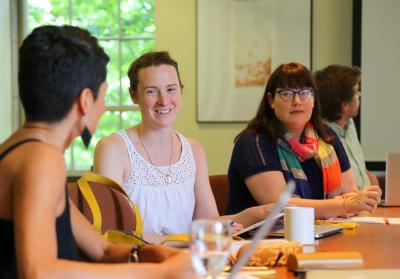
The Simpson Center offers annual summer fellowships for faculty and graduate students to pursue research projects that use digital technologies in innovative and intensive ways and/or explore the historical, social, aesthetic, and cross-cultural implications of digital cultures. The program has three primary goals:
- To animate knowledge—using rich media, dynamic databases, and visualization tools
- To circulate knowledge—among diverse publics
- To understand digital culture—historically, theoretically, aesthetically, and generatively
The Simpson Center gratefully acknowledges the support of a National Endowment for the Humanities Challenge Grant and the Andrew W. Mellon Foundation as well as many donors to the endowment which is underwriting these fellowships.
2026 - 2027 Digital Humanities Summer Fellows





2021 - 2022 Digital Humanities Summer Fellow

Hope Reidun St. John
Picturing the City: Photographic Practice and the Constitution of Urban Place
“Picturing the City” is a multi-site ethnography exploring the constitution of urban place through photographic practice in four Pacific Rim cities. The project focuses specifically on digital mapping as a mode of comparative analysis, inquiry, and form of publicly accessible publication. It aims to create publicly accessible digital maps of photographic practice in Seattle, Vancouver, Hong Kong, and Qingdao using ethnographic data and materials.