Digital Humanities Summer Fellowships
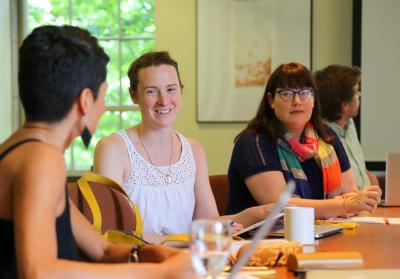
The Simpson Center offers annual summer fellowships for faculty and graduate students to pursue research projects that use digital technologies in innovative and intensive ways and/or explore the historical, social, aesthetic, and cross-cultural implications of digital cultures. The program has three primary goals:
- To animate knowledge—using rich media, dynamic databases, and visualization tools
- To circulate knowledge—among diverse publics
- To understand digital culture—historically, theoretically, aesthetically, and generatively
The Simpson Center gratefully acknowledges the support of a National Endowment for the Humanities Challenge Grant and the Andrew W. Mellon Foundation as well as many donors to the endowment which is underwriting these fellowships.
2026 - 2027 Digital Humanities Summer Fellows




2022 - 2023 Digital Humanities Summer Fellow

Jasmine Mahmoud (she/her/hers)
Digitizing Black Curatorial Practice: Dr. James Washington, Jr. at MOHAI
Digitizing Black Curatorial Practice supports the Winter 2023 exhibition at MOHAI about the works and world of Dr. James Washington, Jr., the Black Mississippi-born artist who spent most of his life living and working in Seattle’s Central District. Rooting this project is the development of a microseminar -- engaging in Black and Digital Curatorial Studies -- to query how digital tools animate and extend the exhibition’s display, history, aesthetics, and community engagement, and how interactive spaces themselves act as sites of archival work, historiography, and anti-racist curatorial practice.